


Find a CBT Therapist
Search through our directory of local clinicians.
Spencer (Xin) Chen
Spotlight on a Researcher
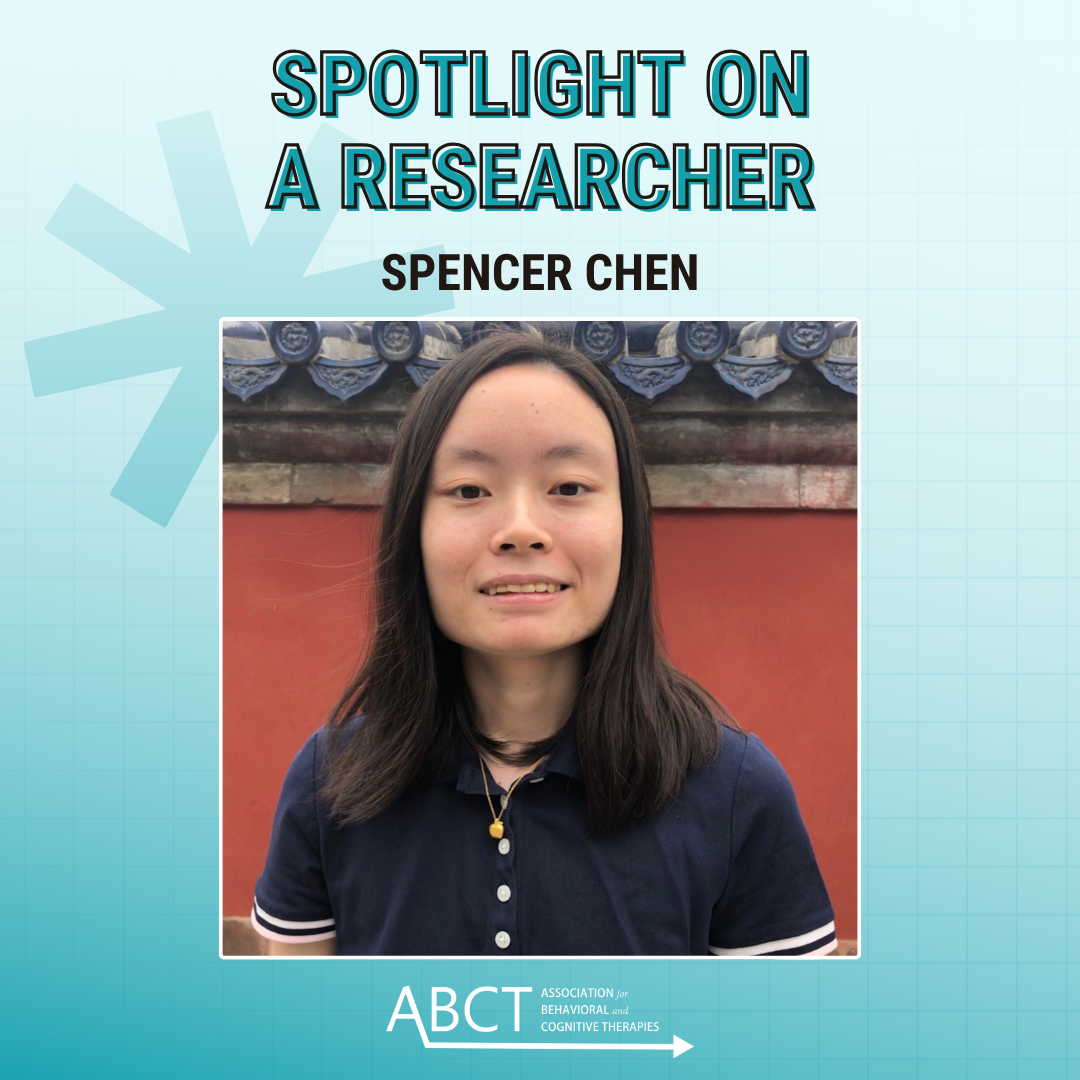
- Name: Spencer (Xin) Chen
- Degree: MA (current PhD student in clinical psychology)
- Pronouns: she/her/hers
- Institution: Simon Fraser University
- Advisor: Dr. Alexander Chapman
- Lab: Personality and Emotion Research Lab
- Project title: “Beyond Suicide Risk: A Cross-Cultural Grounded Theory Study of Life-Oriented Processes in Suicidal Individuals Across Western and Eastern Cultures”
- Is the project a masters, dissertation, or other project: PhD dissertation
Tell us about the project the GSRG is funding.
Traditional suicide research has largely focused on identifying risk factors for suicidal thoughts and behaviours, but recently meta-analytic findings suggest that risk factors are weak predictors of suicidal outcomes and that there has been little meaningful progress in suicide research over the past 50 years (Franklin et al., 2017). A significant gap remains in our understanding of why most individuals who contemplate suicide ultimately do not die by suicide, and what alternative processes may orient them toward life. In response, researchers have recently advocated for life-oriented approaches to suicide prevention that emphasize resilience and the creation of a life worth living (Stritzke & Page, 2020).
However, little is known about how life-oriented thoughts, feelings, and behaviors actually manifest in suicidal individuals, how they interact with suicidal processes, or how these experiences are shaped by cultural context. This study will employ constructivist grounded theory (CGT) to explore life-oriented processes in suicidal individuals of East Asian or Anglo-European descent residing in North America. We will conduct in-depth interviews with participants experiencing current suicidal ideation and a lifetime suicide attempt history.
By centering life-oriented processes, this study seeks to shift the focus away from what is “wrong” with individuals experiencing suicidality and toward leveraging the inherent strengths that help them stay alive. Moreover, given the increasing number of immigrants and the growing diversity of communities in North America, there is an urgent need for culturally responsive suicide interventions. The cross-cultural component of this study will help identify ways to draw on cultural strengths and empower individuals to build lives worth living that are grounded in their cultural values and lived realities.
What does getting this award mean to you?
I am deeply grateful to be selected for the GSRG grant, as it makes it possible for me to pursue a project that I deeply care about. This funding will allow me to recruit a culturally diverse sample of participants experiencing suicidality and provide fair compensation to participants who are experts by experience and deserve to be recognized for their time and contribution to this work. Without this grant, I would likely have to rely on more convenient samples, such as undergraduate students, which would significantly limit the impact and generalizability of the research.
Beyond the practical benefits, receiving the GSRG grant is an important affirmation that others in the research community recognize the value of this work, especially during moments when pursuing a somewhat unconventional line of research that deviates from mainstream, risk-focused approaches to suicide prevention can feel isolating. This recognition is deeply meaningful and further motivates me to continue advancing research that not only helps people survive suicidal crises but also supports them in building a life worth living – a life they want to stay alive for.
How has ABCT contributed to your development as a researcher and clinician?
ABCT has significantly contributed to my professional development by providing an annual conference platform that fosters intellectual stimulation, research dissemination, and networking among like-minded researchers. I have been fortunate to present my work at the last two ABCT annual conferences, and engaging with fellow members has sparked new insights and ideas in my research. Moreover, the ABCT special interest groups (SIGs) offer valuable opportunities to connect with others who share similar research and clinical interests. I also greatly appreciate the student-focused workshops and events held during the conference. For example, attending the workshop on GSRG grant writing at the 2024 conference was extremely helpful during my GSRG application process.
How did you first become involved in research? What was this first research experience like?
As a person with multiple minoritized identities, I first became interested in psychology research during my undergraduate studies when I noticed many gaps in the broader psychology literature that did not fully represent my cultural background and other aspects of my identity. In 2020, I joined the Intergroup Relations and Social Justice Lab, directed by Dr. Steve Wright, who introduced me to a valuable social justice perspective within psychology research. Later, I combined my interest in suicide research and social justice and conducted my first independent research project (an honours thesis) in collaboration with crisis line organizations across Canada. This project examined the dehumanization of suicide attempt survivors by mental health service providers. Throughout my honours experience, I developed a deep appreciation for every step of the research process, from community partnership and data analysis to manuscript writing, and became determined to dedicate my life to research.
What have you found most rewarding about your research?
One of the most gratifying aspects of conducting qualitative research on suicide is the opportunity to amplify the voices of people with lived experience of suicidality. Through their stories, I have been repeatedly inspired by the tremendous resilience they demonstrate, even in the darkest moments of their lives. I have come to see them as more than a constellation of DSM diagnoses or symptoms. It is deeply fulfilling to contribute to a growing body of work that challenges deficit- or pathology-focused views of suicidality. I am infinitely grateful to my supervisor, Dr. Alex Chapman, for giving me the freedom and support to pursue this important line of research.
How do you balance research with the other demands of being a graduate student?
As a PhD student in clinical psychology navigating an ultra-competitive field, I have to wear many “hats,” such as researcher, student clinician, teaching assistant, and so forth. More importantly, however, I am a human first and foremost, and over the years, I have come to value self-care, which also helps me become an effective researcher and clinician. Work-life balance is an ongoing challenge, but I have learned to better appreciate my limits and to create a structure that works for me. I consistently schedule self-care activities throughout the week and set up a priority system for my work. For example, I have learned that my mind is sharpest in the morning, so I reserve that time for focused writing tasks, while leaving administrative duties for the afternoon when my energy tends to dim. My mentor, Dr. Alex Chapman, has been my biggest role model in modeling a sustainable and balanced work schedule, and I really look up to him when it comes to optimizing my own workflow.
What drew you to this particular research question?
I came to this research question because, while most suicide researchers focus on understanding why suicidal people want to die, I am particularly interested in exploring the other side of the story: why suicidal people choose to live. Despite experiencing profound suffering and psychological pain, the majority of individuals with suicidal thoughts do not die by suicide, and I believe that there is deep, often overlooked wisdom in those moments of choosing life or deciding not to act on one’s suicidal thoughts. In addition to understanding people’s capacity for suicidal behaviours, I am curious about the capacity to refrain from suicidal behaviours – something many individuals demonstrate everyday, often quietly and without any recognition.
In addition, as a Chinese international student studying at a Canadian university, I have been immersed in traditional Chinese cultural values while also being exposed to Western academic and clinical frameworks. This bicultural perspective has helped me appreciate the potential cultural source of risk and resilience to suicidality and has fostered a deep passion for culturally informed approaches to suicide prevention and life promotion.