

Find a CBT Therapist
Search through our directory of local clinicians.
Joanna Arch
Spotlight on a Researcher
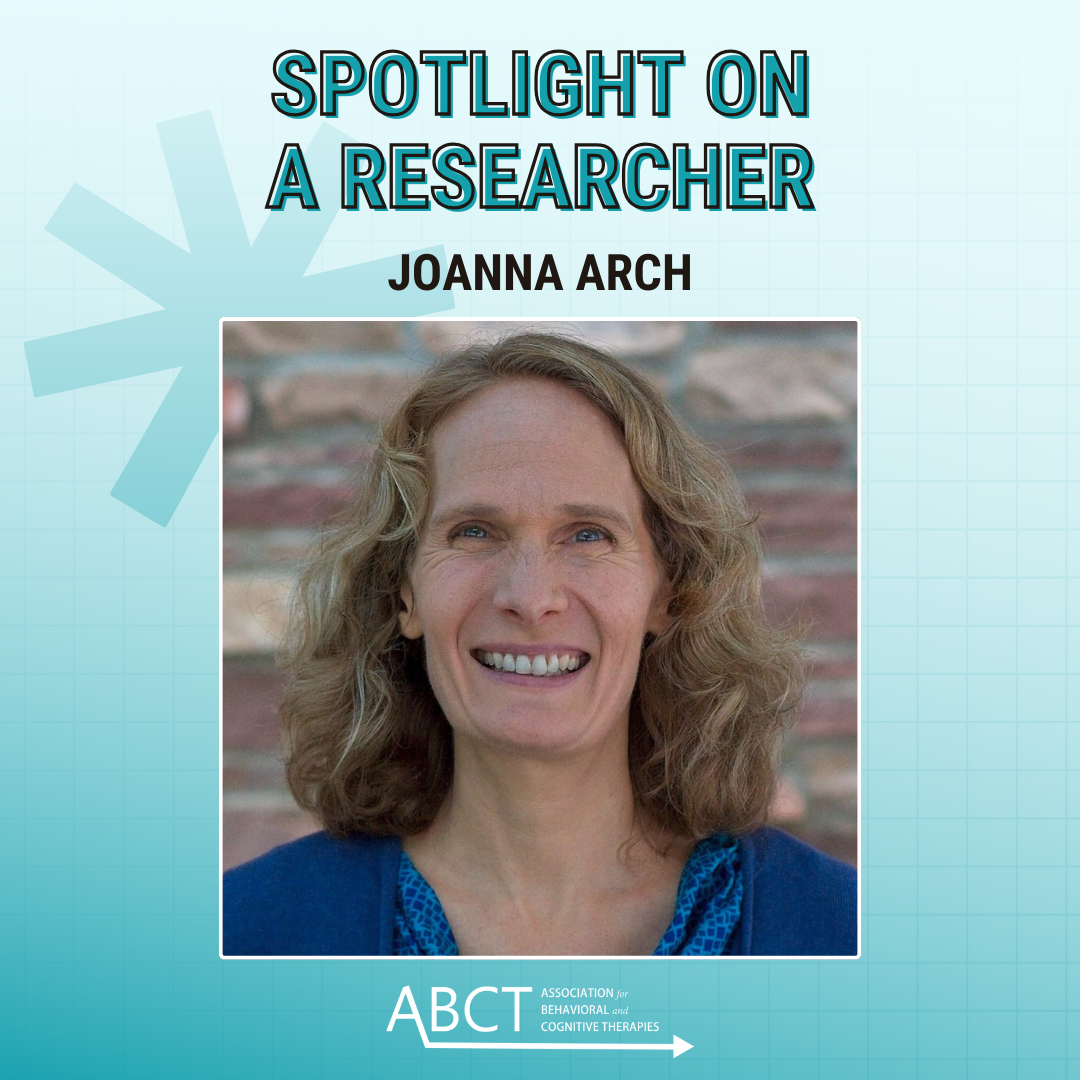
- Name: Joanna Arch
- Degree: Ph.D.
- Pronouns: she/her/hers
- Institution: University of Colorado Boulder, Department of Psychology and Neuroscience
- How long have you been a member of ABCT? Since 2003 or 2004, at the beginning of graduate school!
Dr. Joanna Arch is a Professor in the Department of Psychology and Neuroscience and the Inaugural Yvonne Kristy Endowed Chair in the Renée Crown Wellness Institute at the University of Colorado Boulder. She is a Member in Cancer Prevention and Control at the University of Colorado Cancer Center, and a licensed clinical psychologist.
Her research focuses on developing and evaluating interventions designed to address anxiety disorders in broad adult populations, and to improve anxiety and behavioral adherence outcomes among adults with cancer, with a focus on mindfulness, compassion, and acceptance-based interventions. She has published over 100 journal articles and chapters. Dr. Arch’s work has received funding from the National Institutes of Health, American Cancer Society, the Templeton Foundation, the National Comprehensive Cancer Network/AstraZeneca, and the Yvonne Kristy Endowed Chair.
What have you found most rewarding about your research?
I enjoy many things about the research process. First, I love that we get to use our creativity, logic, and conceptual thinking to dream up interesting ideas to test. There are few jobs that allow us to not only use our creativity, but to use it to advance shared knowledge toward the goal of improving care for people who are suffering. I cannot imagine doing work that is better than that!
Second and relatedly, it is a great privilege to work with people at their most vulnerable (in my case, people with anxiety disorders and people who have been diagnosed with cancer) and to develop and evaluate interventions that aim to support their mental health and well-being.
Third, I thoroughly enjoy getting to work with interesting, inspiring, brilliant, and passionate students and faculty from around the world. Good collaboration is like any good partnership – there is mutual learning and growth, give and take, and fun! There is nothing quite like the synergy of two or more minds coming together to advance a research idea or study.
What tips can you offer to colleagues trying to start a research lab or begin a career in research?
There is a lot of great advice out there for researchers – the importance of disciplined writing, cultivating persistence and grit, trusting yourself, seeking good mentors, and so forth. I believe in all of those! However, I want to highlight cultivating opportunities and remaining open to them, even if they are outside of our comfort zone. For example, I was introduced to an oncology social worker whom I connected with right away. She convinced me that my anxiety research was highly relevant to cancer populations. I was highly skeptical, but now we have been collaborating for more than a dozen years – without her, I would not have pursued psycho-oncology research (my largest research program). In another example, I attended a conference and randomly met someone who told me about a tenure-track job at the University of Colorado Boulder. I didn’t feel ready for a job yet, but applied anyway, and to my great surprise, got the job.
Contrary to popular belief, there is much we can do to cultivate opportunities! At all stages of our research careers, and especially when we start out, we can maintain an open mind about where this journey will take us and take action to bend the arc of opportunity in our favor. We can push ourselves to attend and meet people at conferences. We can make the time and effort to write papers and presentations to get our work out there. We can take risks and apply for opportunities even if we don’t feel quite ready. We can allow ourselves to be influenced by the best minds and most interesting people around us to advance our research ideas and methods. We can push ourselves to try new things, to keep learning, and to risk failing. These behaviors increase the odds that we will create opportunities – that by keeping an open mind, working hard, and putting ourselves out there, we will create synergy for developing new, fun, and powerful research ideas and collaborations.
Please comment on a research methodology that you are using in your research.
Before graduate school, I spent four years as a community organizer serving diverse communities in Boston. In those years, I gained experience in connecting with people from a myriad of backgrounds, speaking to community leaders, and listening to the needs of community members. In the back of my mind, I was curious to find a way to do research that incorporated these skills and approaches. Acting within an endowed chair role at the Renée Crown Wellness Institute at UC Boulder (an Institute directed by Dr. Sona Dimidjian) now allows me to champion co-design and co-adaptation intervention work in youth as part of my work, and their teams have conducted groundbreaking participatory research studies that are excellent models for advancing the field. Please see resources.
Before this, my lab had been studying ways to improve treatment outcomes for social anxiety disorder and related symptoms for many years, particularly in college students. A former doctoral student, Liz Slivjak, developed a wonderful workshop-based intervention in my lab for conducting group exposures for social anxiety. Thus, we met with experts at the Crown Institute in participatory co-design to see if we could adapt this workshop to better meet the needs of socially anxious college students. We developed a paid co-design fellowship in which former workshop participants were invited back to redesign the workshop for maximum effectiveness and relevance to college student contexts. The co-design students designed exposures we never would have thought of – college seminars in which students are required to debate in combative ways and participating in group job interviews with potential employers. We learned so much from them!
We thought, if college undergraduates can design exposures, why can’t they co-lead the workshops? Delivering exposure therapy in workshop (or meeting) format, outside of healthcare settings, and using former participants as workshop co-facilitators, lowers stigma and barriers to access. Many of our most accessible interventions such as 12-step programs for addictions and Toastmasters for fear of public speaking share these features. I would love to see a world in which anxious college students can access good exposure therapy at low cost and can use their experience to benefit others and give back. Peer-led workshops are one place to start!