


Find a CBT Therapist
Search through our directory of local clinicians.
Giovanni Ramos
Spotlight on a Researcher
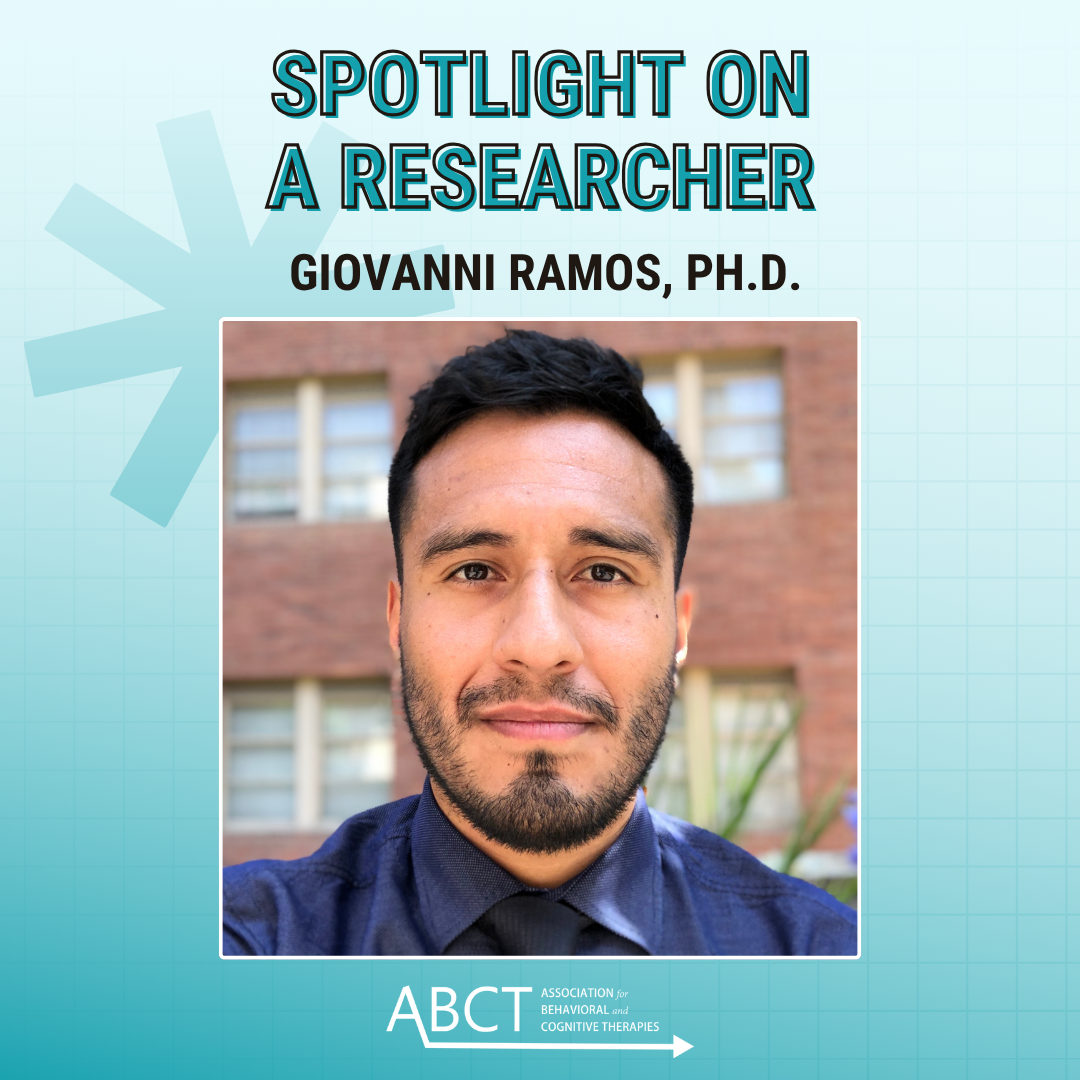
- Name: Giovanni Ramos
- Degree: PhD
- Pronouns: He/His/El
- Institution: University of California, Berkeley
- How long have you been a member of ABCT? Since 2017, when first I started grad school.
Giovanni “Gio” Ramos is an Assistant Professor in Clinical Science at the University of California, Berkeley, where he directs the Mental Health Equity in Access and Treatment (mHEAT) Lab. His research aims to advance mental health equity among racially and ethnically minoritized populations by 1) identifying risk and resilience factors that influence the mental health of marginalized groups, 2) enhancing the cultural and contextual fit of mental health treatments through data-driven adaptations and implementation strategies, and 3) using digital tools to increase the accessibility of mental health services.
What drew you to your particular area of research?
I grew up in an impoverished community in Mexico City, where there’s a lack of economic and educational opportunities, limited access to health care, and disproportionate exposure to stressors such as crime and community violence. In other words, I have firsthand experience of how social and systemic forces shape the well-being of many communities. These personal experiences motivated me to pursue a career in clinical psychology.
As a clinician in Mexico, I had the opportunity to work with families with a background similar to my own and realized that our current model of once-a-week-for-an-hour-in-a-clinic, with homework in between sessions, did not work for many of my clients due to competing demands and limited resources. Similarly, our treatments often focused on what was “wrong” with them, ignoring all the assets in their lives; something that was somewhat ironic, considering these individuals endured significant day-to-day adversity and yet navigated life resiliently for the most part. To my surprise, I also found a similar pattern here in the US after moving to this country in 2013: Low-income families and those from racially and ethnically minoritized groups rarely benefited from the mental health system, and sources of resilience in their lives were not leveraged to improve their well-being.
My dissatisfaction with the status quo of these mental health systems motivated me to pursue a career in research. In fact, you can directly trace back those personal and professional experiences to my current program of research: I examine sources of risk and resilience in people’s lives; I try to improve the cultural and contextual fit of evidence-based treatments so that they suit people better; I also use digital tools to make mental health care available beyond traditional care settings.
What have you found most rewarding about your research?
The real impact that this work can have on people’s lives. For instance, a line of my research has focused on how Latinx families respond to parent-child interaction therapy (PCIT), a behavioral parent training program for children with behavior problems. Across several studies, I’ve identified that Latinx caregivers, especially Spanish speakers, use significantly more directive parenting strategies often coded as “Don’t Skills” in PCIT, leading to disparities in treatment length despite experiencing similar treatment gains as White families. These findings have informed the creation of new PCIT skill benchmarks currently in use in community-based clinics serving Latinx families in California.
In another study, we provided racially and ethnically minoritized individuals with a digital intervention aimed at reducing mental health symptoms due to discrimination. To me, what was especially memorable about this project was how often participants thanked us for creating a program that addressed a unique problem faced by these groups. Many expressed that other mental health services often don’t feel welcoming or are not even available in their communities in the first place. In the end, approximately 50% of participants who used the app for ~10 minutes a day for four weeks experienced clinically significant reductions in stress, anxiety, and depression.
What is one challenge about your research that you didn’t anticipate before you started the work, and how have you dealt with this?
The biggest challenge has been how mental health disparities work is often evaluated in our field. I can’t recall how many times my studies have been desk rejected because editors deemed the work “not of broad interest” and asked me to submit to a “specialized journal” instead. I’ve often received methodological critiques that led to rejections, while studies with similar limitations (but without a focus on disparities or diverse groups) are published in those same journals. Once, I was even labeled an “activist who politicizes science” by a reviewer!
To address these issues, I strive to conduct the most rigorous work possible by preregistering hypotheses and analyses, performing extensive sensitivity analyses, making data and code publicly available, and anticipating common critiques (e.g., the absence of a White “control group”). I’m also pretty intentional about where I submit my work. I scan editorial boards and previous issues to determine whether mental health disparities work will be well received and assessed fairly—there are some very prestigious journals in our field that I no longer consider. Finally, I’ve tried to be part of the change I wish to see by joining the editorial board of our own ABCT’s Cognitive and Behavioral Practice as an Associate Editor. In this role, I’ve been very intentional about diversifying the pool of ad hoc reviewers and board members, inviting more early-career and mental health disparities researchers to get involved with our journal. These scholars bring new theoretical and methodological expertise to the peer-review process, as well as diverse perspectives often lacking in our field.
If you weren’t pursuing a career in psychology, what would you be doing?
My dream as a child was to be an archaeologist! I wanted to travel the world, conduct excavations, and explore ancient ruins. I was fascinated—and still am—by the idea of understanding the everyday life of individuals who lived hundreds or even thousands of years before our time. How did they make sense of the world around them? How did their beliefs shape their behavior? Can we trace our own way of thinking and doing back to them? In a way, you can say that I’ve always been interested in studying psychology; the only difference is that before I was focused on past behavior!
.