Find a CBT Therapist
Search through our directory of local clinicians.
ABCT Bylaws
BYLAWS
Association for Behavioral and Cognitive Therapies, Inc.
Article I
Name, Seal, Mission, and Purposes
- Section 1. Name
The name of this Association shall be Association for Behavioral and Cognitive Therapies, Inc., also referred to herein as “ABCT” and the “Association.” - Section 2. Corporate Seal
The Association shall have a Corporate Seal upon which shall be inscribed the name of the Association, the year of its Association, and the words “Corporate Seal, New York.” - Section 3. Mission Statement
The Association is a multidisciplinary Association committed to the enhancement of health and well-being by advancing the scientific understanding, assessment, prevention, and treatment of human problems through the global application of behavioral, cognitive, and biological evidence-based principles. - Section 4. Purposes
The purposes of the Association are to globally:- Encourage innovations that advance scientific approaches to behavioral, cognitive, and biological evidence-based approaches to behavioral health;
- Promote the utilization and dissemination of behavioral, cognitive, and biological evidence-based approaches to behavioral health;
- Facilitate professional development, interaction, and networking among members;
- Promote ethical delivery of science-based interventions;
- Promote health and well-being through a commitment to diversity and inclusion at all levels;
- Collaborate with global partners in the development, evaluation and dissemination of Cognitive Behavioral Therapy (CBT) and related evidence-based treatment.
Article II
Members
- Section 1. Qualification
Membership in ABCT is open to professionals and students in disciplines that are relevant to the mission statement as determined by the Board (e.g., psychology, psychiatry, social work, medicine, nursing, dentistry, rehabilitation, and education). Each member shall pay dues and other fees established by the Board of Directors from time to time. Additional qualifications of membership may be prescribed by the Board from time to time. - Section 2. Suspension and Termination of Membership
- Conduct. Any member may be suspended for a period or expelled from the Association for cause including, but not limited to, violation of any of the Bylaws or rules of the Association, or for public conduct prejudicial to the best interest of ABCT.
- Suspension or expulsion. Suspension or expulsion will necessitate proof of representation of one’s membership in ABCT as certification of one’s qualifications as a behavior therapist or researcher, proof of substantial misrepresentation on the membership or fellows’ application form, or proof of moral turpitude or conviction for criminal or other serious legal offenses.
- Failure to Pay Dues. Any member may be suspended for a period or expelled by the Boord of Directors upon failure to pay dues within ninety (90) days after such dues become due.
- Procedure. Suspension or expulsion shall require the affirmative vote of at least two-thirds (2/3) of the Board of Directors at a meeting where quorum exists. A statement of charges shall have been sent electronically or mailed, registered, to the last known address of the member so charged at least fifteen (15) days prior to the action of the Board of Directors. The statement shall also include a notice of the time and place where the Board of Directors shall meet to take action on the charge. The member so charged shall have, at that time and place, an opportunity to present their defense.
- Death. Membership shall automatically terminate upon the death of the member.
- Resignation. Any member may resign from membership at any time by delivering a written resignation to the Association.
- Section 3. Category of Members
The Association shall have six (6) categories of membership as follows:- Full Members. Full membership in ABCT is open to all persons who agree with the purposes and objectives of the Association and who meet the following requirements: Persons who are responsible professionals and members in good standing of Associations representing their primary discipline (e.g., the American Psychological Association, the American Psychiatric Association, or the National Association of Social Workers), or in lieu of these memberships possess other acceptable qualifications and experience as defined by the Board of Directors, and who are:
- practicing cognitive behavioral clinicians;
- engaged in research or other activities pertinent to the development and advancement of cognitive behavioral therapies; or
- interested in acquiring professional knowledge and competence in some aspects of cognitive behavioral therapies, with a view toward eventual participation.
- Qualifications for full membership may be waived at the discretion of the Board of Directors.
- Fellow Members. Fellow membership, an honorific in ABCT, is available to individuals who:
- have a graduate degree in a field with relevance to the ABCT mission;
- have current Full membership of at least ten (10) years since granting of their graduate degree;
- are actively engaged in the advancement or practice of behavioral and/or cognitive therapies;
- have at least fifteen (15) years of acceptable professional experience post meeting all requirements for their graduate degree.
- are approved by the Fellowship Committee; and
- are approved by the Board of Directors.
- New Professional Members. New professional membership is available to all individuals who have earned their terminal degree within the past year, including postdoctoral trainees. They are granted a special transition rate with all the benefits of Full membership (except that they cannot hold office) for a three (3)-year period. Membership dues increase with each year of New Professional membership but remain lower than Full Member dues.
- Student Members. Student membership is available to individuals who are enrolled in a program of study leading to a bachelor’s, master’s, or doctoral degree in behavioral therapies or a related field who have not yet earned their terminal degree.
- Postbaccalaureate Members. Postbaccalaureate membership is available to all individuals in transition who have graduated with a minimum of a bachelor’s-level degree and are working or volunteering in a mental health facility (community clinic, private practice) or academic institution (e.g., psychology department, medical school). Membership in this category is not intended for master’s-level professionals and no individual may be a Postbaccalaureate Member for more than three (3) years in total.
- Associate Members. Associate membership is available to those who do not meet all the professional requirements for full membership but whose credentials otherwise are acceptable to the membership committee.
- Full Members. Full membership in ABCT is open to all persons who agree with the purposes and objectives of the Association and who meet the following requirements: Persons who are responsible professionals and members in good standing of Associations representing their primary discipline (e.g., the American Psychological Association, the American Psychiatric Association, or the National Association of Social Workers), or in lieu of these memberships possess other acceptable qualifications and experience as defined by the Board of Directors, and who are:
- Section 4. Dues
The Board of Directors shall from time to time fix dues and other fees at such rates, schedules, or formulas as deemed appropriate. For those living outside the U.S. and Canada, membership dues will be fixed by the Board of Directors in accordance with the country of origin. An initiation fee will be charged to all new members. The initiation fee is waived for student members. - Section 5. Privileges of Membership
Full and Fellow Members may nominate, vote, and hold office. New Professionals, Students, Postbaccalaureate, and Associate Members may nominate and vote, but may not hold office. - Section 6. Membership Year
Membership begins on the date the member pays their initial dues in full and extends for the ABCT fiscal year, November 1 to October 31. Late membership is not pro-rated and ends at the ABCT fiscal year.
Article III
Member Meetings
- Section 1. Annual Meeting
A regular meeting of members shall be held during the annual convention for the principal purpose of exchanging information and communication between the members and the Board of Directors. The Secretary-Treasurer shall cause every member in good standing to be provided with written notice at least two (2) weeks in advance of the meeting, setting forth the time and place of that meeting.Any decision taken at such a meeting shall be subject to ratification by membership in a referendum.
- Section 2. Special Meetings
Special meetings of the members may be called by the President, at the written request of at least five (5) members of the Board of Directors, or at the written request of at least ten (10%) percent of the voting members.
The Secretary-Treasurer, or someone designated by the Secretary-Treasurer, is responsible for notices of such special meetings which shall be communicated to the membership via the contact information provided to ABCT by each member at least two (2) weeks prior to the date of the meeting. Such notices will include meeting time and place and the reason for the meeting and the agenda. No business other than that specified on the agenda shall be transacted at these special meetings except by unanimous consent of all members present. - Section 3. Waiver of Notice
A member may waive any notice required by law, ABCT’s Certificate of Incorporation, or these Bylaws before or after the date of the meeting. The waiver shall be in writing, signed by the member entitled to the notice, and delivered to the Association. The attendance of any member at a meeting of the members without protesting prior to the conclusion of the meeting the lack of notice of such meeting, shall constitute a waiver of notice. - Section 4. Quorum
Ten (10%) percent of the voting members or (100) one hundred members present at a duly called meeting shall constitute a quorum for the transaction of business at any meeting of the members. - Section 5. Manner of Acting
Each member in good standing entitled to vote shall have one (1) vote. The act of a majority of voting members present at a meeting where quorum exists shall be the act of the membership, unless a greater number is required by law, ABCT’s Certificate of Incorporation, or these Bylaws. - Section 6. Participation by Electronic Communication Technology
Member meetings may be held partially or solely by means of electronic communication technology, provided such electronic communication technology enables the Association to: (a) verify that each person participating electronically is a member; (b) provide each member participating electronically with a reasonable opportunity to propose, object to, and vote upon a specific action to be taken by the member, and to see, read, or hear the proceedings of the meeting substantially concurrently with those proceedings; and (c) record and maintain a record of any votes or other actions taken by electronic communication at the meeting.
Article IV
Board of Directors
- Section 1. Authority
The Association’s affairs shall be exercised and managed by the Board of Directors. - Section 2. Composition of the Board
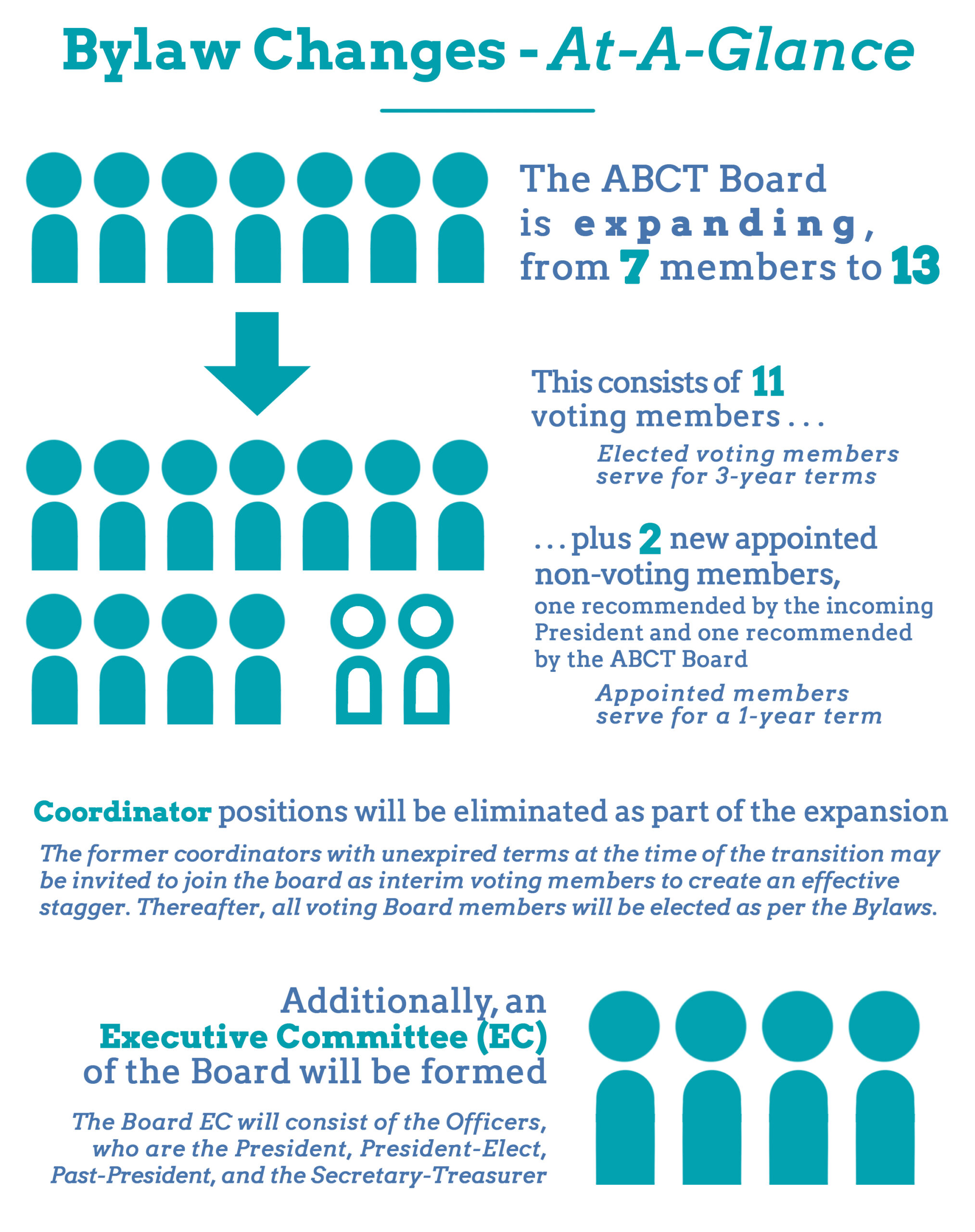
The Board of Directors shall consist of no more than thirteen(13) Directors, as follows:- up to eleven (11) Directors with voting rights (“Directors At-Large”);
- up to two (2) Directors without voting rights, one (1) of which shall be a Student Member or New Professional Member (“Appointed Directors”); and
- The Association’s President, Past-President, President-Elect, and Secretary-Treasurer shall each be an ex officio Director with voting rights.
- Section 3. Term of Office
Directors-At-Large shall serve a term of three (3) years and until their successors are duly elected and qualified. Appointed Directors shall serve a term of one (1) year and until their successors are duly appointed and qualified. Directors At-Large may serve consecutive terms without limitation. Appointed Directors may serve up to one (1) full term. Upon expiration of an Appointed Director’s first full term, the Appointed Director shall be ineligible for re-appointment as an Appointed Director but shall remain eligible to be elected as a Director At-Large. - Section 4. Elections
Directors At-Large shall be elected by the voting members according to the rules and procedures specified by the Committee on Leadership and Elections; provided such rules and procedures do not conflict with these Bylaws or applicable law. Up to one (1) Appointed Director shall be appointed by the Board of Directors upon recommendation by the incoming President. Up to one (1) Appointed Director shall be appointed by the Board at its discretion. The process of conducting the election of Directors shall be the responsibility of the Committee on Leadership and Elections as determined by the Board of Directors. - Section 5. Resignation
Any Director may resign at any time by filing a written resignation with the Corporation’s President or Secretary-Treasurer, or by giving oral or written notice at any Board of Directors meeting. - Section 6. Removal
Directors At-Large may be removed with or without cause by the voting members at a meeting where quorum exists. Appointed Directors may be removed with or without cause by vote of a majority of Directors then in office. - Section 7. Vacancies
In the event a vacancy occurs on the Board of Directors for any reason, the Board of Directors may fill the vacancy for the remaining portion of the term. - Section 8. Compensation
Directors shall not receive compensation for serving as a Director. However, Directors may be reimbursed for reasonable expenses incurred in connection with carrying out the Association’s affairs, provided that such reimbursements are authorized by the Board of Directors in writing. Notwithstanding the foregoing, Directors serving in other roles within the Association may receive reasonable compensation for serving in such roles, provided such compensation is authorized by the Board of Directors in writing. - Section 9. Coordinators
These Bylaws eliminate the previous Coordinator positions within the Association. No later than one (1) year following the date these Bylaws are duly approved and adopted, the Board of Directors may appoint any person to At-Large Directorship who immediately prior to the adoption of these Bylaws was a Coordinator in good standing. If so appointed, each former Coordinator will serve as a voting member of the Board only for period equivalent to the remaining tenure of their previous Coordinator role. Thereafter, all At-Large Directors shall be elected by the voting members as stated in Section 2 of this Article IV.
Article V
Board Meetings
- Section 1. Meetings of the Board
Regular meetings of the Board of Directors shall be held no less than four (4) times during each year at such time and in such a manner as the Board may prescribe, but in no event less than once per calendar quarter. One (1) such regular meeting of the Board of Directors shall be held during the annual convention of the Association, or, if not held at that time, as soon thereafter as convenient. A special meeting of the Board of Directors may be called at any time by the President. - Section 2. Notice and Waiver of Notice
Regular and special meetings of the Board of Directors shall be preceded by at least two (2) days’ notice of the date, time, and place of the meeting. Unless otherwise required by law, the Association’s Certificate of Incorporation, or these Bylaws, notices may but need not describe the purpose or business to be transacted at the meeting. A Director may waive any notice required to be given hereunder before or after the meeting by submitting a waiver of notice to the Association. Such waiver of notice may be written or electronic. If written, the waiver must be executed by the Director signing such waiver or causing their signature to be affixed to such waiver by any reasonable means including but not limited to facsimile signature. If electronic, the transmission of the waiver must be sent by electronic mail and set forth, or be submitted with, information from which it can reasonably be determined that the transmission was authorized by the Director. A Director shall be deemed to have waived notice if the Director attends the meeting without protesting prior thereto or at its commencement. - Section 3. Quorum
The quorum for the transaction of business at meetings of the Board of Directors shall be a majority of the voting Directors then in office. - Section 4. Manner of Acting
At any Board meeting, each Director entitled to vote shall have one (1) vote. The act of a majority of voting Directors present at a meeting where quorum exists shall be the act of the Board of Directors, unless a greater number is required by law, the Association’s Certificate of Incorporation, or these Bylaws. No proxies shall be permitted. - Section 5. Participation by Electronic Communication Technology
Any one (1) or more Directors may participate in a meeting of the Board of Directors by means of conference telephone or similar communications equipment or by electronic video screen communication. Participation by such means shall constitute presence in person at a meeting as long as all persons participating In the meeting can hear each other at the same time and each Director can participate in all matters before the Board of Directors, including, without limitation, the ability to propose, object to, and vote upon a specific action to be taken by the Board of Directors. - Section 6. Action Without a Meeting
Any action required or permitted to be taken by the Board of Directors may be taken without a meeting if all members of the Board consent to the adoption of the resolution authorizing the action. Such consent may be written or electronic. If written, the consent must be executed by the Director by signing such consent or causing their signature to be affixed to such consent by any reasonable means including but not limited to facsimile signature. If electronic, the transmission of the consent must be sent by electronic mail or other electronic means and set forth, or be submitted with, information from which it can reasonably be determined that the transmission was authorized by the Director. The resolution and the written consents thereto shall be filed with the minutes of the proceedings of the Board of Directors.
Article VI
Officers
- Section 1. Number
The Association’s principal officers are a President, President-Elect, Past President, and Secretary-Treasurer. The same individual may simultaneously hold more than one (1) office, provided, however, the same individual may not simultaneously hold offices of President and Secretary-Treasurer. - Section 2. Election and Term of Office
The President-Elect and Secretary-Treasurer shall be elected by voting members through the Leadership and Election Committee process. The President-Elect, President, and Past President shall each hold office for one (1) year and until a qualified successor is duly elected, as follows: (i) The President-Elect, after completing their full term in office shall automatically transition into the President position; and (ii) The President, after serving their full term in office shall automatically transition into the Past President position. For avoidance of doubt, the automatic succession of offices described in this Section shall not apply to any officer elected to fill a vacancy for the unexpired portion of their predecessor’s term, unless otherwise provided by the Board by resolution electing them. The Secretary-Treasurer shall serve a three (3)-year term of office, which shall begin the year immediately following their election. During the year prior to assuming office the Secretary-Treasurer-Elect shall endeavor to become familiar with the duties of that office by maintaining a close working relationship with the incumbent Secretary-Treasurer. The process of conducting the election of officers shall be the responsibility of the Committee on Leadership and Elections as determined by the Board of Directors. - Section 3. Qualifications
Candidates for any office shall be Full or Fellow members of the Association in good standing. With the exception of the two non-voting appointed board positions. - Section 4. Vacancies
If the office of President-Elect becomes vacant, a special election will be held and the successful candidate will be installed as President or President-Elect as the case may be, within three (3) months of when the vacancy occurred. If the office of Secretary-Treasurer becomes vacant with more than one (1) year remaining in the term of office, a special election will be held and the successful candidate will be installed as Secretary-Treasurer within three (3) months of when the vacancy occurred to serve the remainder of the term. If the office of Secretary-Treasurer becomes vacant with less than one year remaining in the term of office, the Board may appoint a voting member of the Association to fill the position for the balance of the term. - Section 5. Resignation and Removal
Any officer may resign at any time by delivering written notice of resignation to the President or Secretary-Treasurer. Any such resignation shall take effect at the time specified therein; and the acceptance of such resignation shall not be necessary to make it effective. Any officer may be removed with or without cause by majority vote of the Directors present at a meeting where quorum exists. Any such removal shall be without prejudice to the contract rights, if any, of the individual removed. Election or appointment shall not itself create contract rights. - Section 6. Duties of Officers
- President-Elect. In the President’s absence at any meeting except the Board meeting during the annual convention, the President-Elect shall preside. In case of absence, disability, or resignation of the President, the President-Elect shall perform the duties of the President. While in office, the President-Elect shall nominate, for approval by the Board, the person who serves as Program Chair of the Association’s Annual Convention during their term. The President-Elect shall work as closely as possible with the President on all executive matters.
- President. The President presides at and schedules meetings of the Board, the annual meeting of the Association, and any special meetings that may be called. The President, after consultation with the Chief Executive Officer, shall prepare the agendas for said meetings. The President may make nominations for approval by the Board for any appointive position which must be filled except as otherwise stated. The President shall not hold any other position on the Board while in office. The President shall be responsible in all matters, stated or implied, that are related to the welfare, stature and proper operation of the Association. The President shall perform such other duties as are necessarily incident to the office of President or as may be prescribed by the Board.
- Past-President. The Past-President shall preside at the Board meeting during the annual convention in the absence of the President, and at all meetings in the absence of both the President and the President-Elect.
- Secretary-Treasurer. The Secretary-Treasurer is responsible for the receipt, custody and disbursement of all funds and securities of the Association. The Secretary-Treasurer shall make a written and oral report of the financial condition of the Association to the Board and the general membership at the annual meeting. The Secretary-Treasurer shall chair the Finance Committee. The Secretary-Treasurer shall receive the auditor’s report and submit to the President a biannual financial report, detailing monies received and expended. The Secretary-Treasurer shall keep the minutes of all meetings. The minutes of each meeting must be sent to the Directors within one month thereafter. Such duties of the Secretary-Treasurer as may be specified by the Board may be delegated to the Chief Executive Officer or a designated member of the office staff.
- Section 7. Compensation
Officers, other than those who are full-time staff members, shall not receive compensation for serving as officers, but may be reimbursed for reasonable expenses incurred in connection with carrying out the Corporation’s affairs, provided that such reimbursements are authorized by the Board in writing.
Article VII
Committees
- Section 1. Board Committees
The Board of Directors by a majority vote of Directors then in office may create one (1) or more committees having such Board-delegated powers as specified in the Board resolution or Board-approved committee charter creating them (“Board Committee”). Board Committee shall consist of three (3) or more Directors. No Board Committee shall have the authority to: (i) fill vacancies on the Board of Directors or any committee; (ii) fix the compensation of any director; (iii) amend or repeal any of these Bylaws or adopt new Bylaws; (v) amend or repeal any resolution of the Board of Directors which by its terms shall not be amendable or repealable; (iv) elect or remove officers or directors; (vi) approve a merger of plan of dissolution; (vii) authorize the sale, lease, exchange, or other disposition of all or substantially all assets of the Association; (viii) approve amendments to the Association’s Certificate of Incorporation.The Association shall have the following standing Committees:
- Executive Committee. The Executive Committee is empowered to act on behalf of the Board of Directors between Board meetings. Decisions made by the Executive Committee shall be reported to the Board of Directors for ratification at the next Board meeting. The Executive Committee shall be comprised of President, President-Elect, Past President, and Secretary-Treasurer.
- Finance Committee. The Finance Committee is responsible for overseeing the Association’s financial health and integrity. It assists the Board by reviewing budgets, monitoring financial performance, overseeing financial policies and controls, and supporting financial planning to ensure resources are used responsibly and in alignment with the Association’s mission.
- Committee on Leadership and Elections. The Committee on Leadership and Elections shall oversee and facilitate the nomination and election of officers and Directors. No member of the Committee on Leadership and Elections shall be a candidate for office or have an inordinate interest in a question or change in bylaws or constitution put to vote by the membership.
- Section 2. Advisory Committees
The Board of Directors may create one (1) or more non-Board committees as deemed necessary or convenient (“Advisory Committees”). Advisory Committees shall not exercise Board-delegated powers but may make non-binding recommendations to the Board of Directors. Advisory Committee members need not be Directors. - Section 3. Committee Chairs
Unless otherwise specified in the Board resolution or Board-approved the members of each committee shall nominate a chair to be approved by the Board of Directors. A term of office of a committee chair shall begin at the next annual meeting following that person’s appointment. Chairs of committees must be members of the Association in good standing. Upon expiration of a committee chair’s first full term, the chair shall be ineligible for reelection as committee chair for one (1) year. - Section 4. Vacancies
Vacancies occurring on any committees Chairs shall be filled by the Board of Directors for the remainder of the term. - Section 5. Removal
Any committee member may be removed with or without cause by at least two-thirds vote of the Board, provided the committee member be notified in writing at least four (4) weeks prior to the meeting where the decision to remove the committee member shall be voted on and the committee member is given an opportunity to appear before the Board of Directors for the presentation of a defense. - Section 6. Meetings and Manner of Acting
Committees shall operate in accordance with the rules and procedures specified in the Board resolution or Board-approved committee charter creating them. In the case where the Board resolution or Board-approved committee charter does not specify rules and procedures, the committee will operate in accordance with the rules and procedures applicable for Board meetings as stated in Article V of these Bylaws. - Section 7. Fiscal Reports
All committees shall present an annual report to the Board of Directors at the meeting held during the annual convention. This report shall include, but not be limited to, a full financial statement on activities and projects and a projected budget for the succeeding year.
Article VIII
Miscellaneous
- Section 1. Fiscal year
The fiscal year of the Association is from November 1 through October 31. - Section 2. Limitation on Expenditures
No officer, director, committee, or member shall expend any money not provided in the budget as adopted or spend any money in excess budget allotment except by order of the Board of Directors. No officer, director, committee, or member can obligate the Association to any financial commitments unless expressly authorized by the Board of Directors in writing or as otherwise stated in these Bylaws. The Board shall not commit the Association to any financial obligation in excess of its current financial resources. - Section 3. Parliamentary Procedure
Unless otherwise stated in these bylaws, all meetings shall be conducted in accordance with Robert’s Rules of Order. - Section 4. Books and Records
The Association shall maintain at its principal office: (a) correct and complete books and records; (b) minutes of the proceedings of the Board, any Board Committees, and any designated bodies of the Board; (c) the names and addresses of its current Directors, officers, and key persons; (d) the Corporation’s current Articles of Incorporation, Bylaws, and Board-approved policies; (e) the most recent annual report filed in the State of New York; and (f) all documents required to be maintained by Associations exempt from federal income tax under Internal Revenue Code Section 501(c)(6). All books and records of the Corporation may be subject to inspection as required by law.
Article IX
Limitations of Liability and Indemnification
- Section 1. No Joint Venture
Nothing herein shall constitute members of ABCT as partners or joint venturers for any purpose. No member, officer, director, employee or member of a committee of ABCT shall be liable for his or her act or failure to act by any other member, officer, director, employee, or member of a committee of ABCT. - Section 2. Indemnification
The Association shall indemnify and save harmless its Directors and officers, including the advancement of applicable fees and expenses, to the fullest extent permitted by law. - Section 3. Insurance
The Board of Directors may authorize the purchase of insurance on behalf of any Director, officer, employee, or other agent against any liability asserted against or incurred which arises out of such person’s status as a Director, officer, employee, or agent of the Corporation or out of acts taken in such capacity, whether or not the Corporation would have the power to indemnify the person against that liability under law.
Article X
Distribution of Assets on Dissolution
In the event of the termination, dissolution, or the completion of the affairs of the Association in any manner or for any reason whatsoever, its remaining assets, if any, shall be distributed to one (1) or more Associations described in Sections 501(c)(6) or 501(c)(3) of the Internal Revenue Code having, generally, the same or substantially similar purposes as the Association, as determined by the Board of Directors.
Article XI
Amendments
Unless member approval is required by the law, the Association’s Certificate of Incorporation, or these Bylaws, these Bylaws may be amended or repealed and new Bylaws may be adopted by the vote of the majority of Directors then in office.