Welcome to Your Home for CBT.
Welcome to the Association for Behavioral and Cognitive Therapies (ABCT). For over 50 years, ABCT and its members have strived to alleviate human suffering through the application of scientific principles.
Find a CBT Therapist
Search through our directory of local clinicians.


Get Help
Resources for individuals and families who are looking for assistance with understanding CBT concerns.

For Professionals
Resources for practicing CBT professionals including clinicians and researchers.

For Students
Resources for those who are studying to become a professional CBT professional.
Behavioral & Cognitive Therapy Resources
Browse through our library of Fact Sheets, Self-Help Books, and other resources.
Fact Sheets
ABCT provides Fact Sheets covering a number of topics.
Self Help Books
ABCT provides Self-Help books covering a number of topics.
Find A Therapist
Search through our directory of local clinicians.
New & Noteworthy
ABCT news and position statements on current events and issues shaping the world around us.
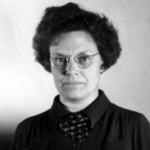 Dr. Mary Cover Jones — Mother of Behavior Therapy - Who was the first behavior therapist?
Joseph Wolpe? Andrew Salter? Knight Dunlap? All good guesses, but all somewhat later than Mary Cover Jones. Who is she?
Some of you already know her work, but maybe not her position in the chronology of behavior therapy.
Dr. Mary Cover Jones — Mother of Behavior Therapy - Who was the first behavior therapist?
Joseph Wolpe? Andrew Salter? Knight Dunlap? All good guesses, but all somewhat later than Mary Cover Jones. Who is she?
Some of you already know her work, but maybe not her position in the chronology of behavior therapy.
 Happy Passover to All Observing - Chag Pesach sameach! We at ABCT would like to wish a sweet Passover to all who observe.
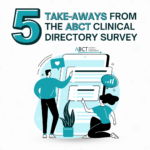 5 Take-aways from the ABCT Clinical Directory Survey - The April tBT featured results of the ABCT Clinical Directory survey conducted in October of last year. The survey gauged interest, user needs, and improvements. The big 5 takeaways are laid out here.
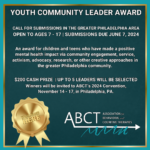 Nominate an Outstanding Young Person for ABCT’s Youth Community Leader Award - Do you know a kid or teen (ages 7-17) that has made a positive mental health impact in the greater Philadelphia area via community engagement, service, activism, advocacy, research, or other creative approaches? Are you that kid or teen? ABCT is seeking nominations for the 2024 Youth Community Leader Award.
 Congratulations to ABCT President-Elect, Steven A. Safren, Ph.D. - We at ABCT wish to extend our sincerest congratulations to our President-Elect, Steven A. Safren, Ph.D., for his Distinguished Faculty Scholar Award from the University of Miami. This award, for which he was nominated by Phillip M. McCabe, the professor and chair of the Department of Psychology at the University of Miami, celebrates the many significant accomplishments of Safren’s clinical practice and research.
  World CBT Day 2024 - World CBT Day coincides with WHO’s World Health Day, and reflects the importance and impact of cognitive and behavioral therapies (CBT) on global health.
 Recognizing Autism Awareness Day - ABCT is proud to acknowledge Autism Awareness Day this year. Nearly half of youth diagnosed with autism spectrum disorders (ASD) experience elevated levels of anxiety. In recent years, studies have explored the methods of treating anxiety in children with ASD using modified CBT techniques.
 Michelle Drapkin - Featured Therapist Michelle Drapkin is the author of "The Motivation Interviewing Path to Personal Change: The Essential Workbook for Creating the Life You Want."
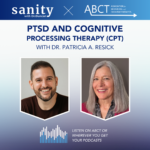 Sanity Podcast with Dr. Patricia A. Resick - On this 2 episode series of Sanity, a CBT Podcast, we delve into PTSD and Cognitive Processing Therapy (CPT) in two enlightening episodes!
Helpful Tips & Featured Articles
 Treating Trauma and Anxiety with CBT - Cognitive Behavioral Therapy (CBT) approaches are typical in treating trauma and anxiety across the lifespan. Trauma, a response to experiencing or witnessing an event that overwhelms your stress response and ability to cope, can be marked by several key components.
 CBT and the Gut-Brain Connection - CBT can be used to treat gut-related issues, especially those caused by stress, by providing psychoeducation, relaxation techniques, and cognitive restructuring to help alleviate symptoms.
  “What Is CBT and Does It Actually Work” Reflection - Determining what kind of therapy is right for you can be a daunting task. A recent article published by Health Conscious titled “What Is CBT and Does It Actually Work” briefly describes cognitive behavioral therapy (CBT), an evidence-based treatment that has been shown to be effective for a variety of concerns.
  Three-Quarters of Those Using CBT-I See Long-Term Improvements in Insomnia - Christina Caron of the New York Times provided a very positive review of CBT-I, Cognitive Behavioral Therapy for Insomnia, that alleviates sleep problems in more than ¾ of users.
 Self-Talk and CBT - Vocal Media’s recent article, “Is It Normal to Talk to Yourself?” discusses both the benefits and harms of self-talk.
  Cognitive Behavioral Therapy to Reduce Post-COVID-19 Fatigue and Poor Concentration - Individuals experiencing fatigue and poor concentration post-COVID-19 infection may benefit from cognitive behavioral therapy (CBT).
 7 Tips to Help Manage Emotions - Jenny Taitz walks the reader through steps that can help with overall emotional management.
 All Children 8 and Older Should be Screened for Anxiety, U.S. Task Force Says - Routine anxiety screenings help parents and professionals monitor children’s mental health, detect early signs of difficulties, and seek services when needed.
Calendar of Events
Live Webinar May 17 - Neurodiversity Matters: Increasing the Effectiveness and Inclusivity of CBT in Clinical Practice with Dr. Janie Hong
Event Date: Friday, May 17 2024
Event Time: 11:30 ET
Get Involved
Join ABCT today to become a part of an active community of CBT Professionals.
Featured Lab
 The Borderline Personality Disorder, Emotion Science, and Treatment Lab (BESTLab) - The Borderline Personality Disorder, Emotion Science, and Treatment Lab (BESTLab), located in the Department of Psychology at Palo Alto University, is directed by Janice Kuo, Ph.D.
Featured Professionals
Showcasing the people and ideas that make our community better for everyone.
Featured Fellow
 Maureen Whittal - This is the first of a series of articles meant to spotlight current Fellows of ABCT. Meet Maureen Whittal, who is a Fellow and also a Member of the ABCT Fellows Committee.
Featured Researcher
 Evan J. White - Evan White, PhD, is an enrolled member of the Absentee Shawnee Tribe of Oklahoma. He belongs to the Shawnee Chapter of the Native American Church of Oklahoma and the Whiteoak Shawnee Ceremonial Grounds.
 Featured Mentor
 Anu Asnaani - Dr. Asnaani is a licensed Clinical Psychologist who currently is the Principal Investigator of the Treatment Mechanisms, Community Empowerment, and Technology Innovations (TCT) laboratory and an Associate Professor in the Department of Psychology at the University of Utah in Salt Lake City, UT.
Featured Therapist
Michelle Drapkin - Featured Therapist Michelle Drapkin is the author of "The Motivation Interviewing Path to Personal Change: The Essential Workbook for Creating the Life You Want."


ABCT Community
Be a part of our online community on social media and in our Member Forums.
 Subscribe to ABCT

ABCT on Facebook
Member Forums
Modular Treatments for Adults
Created On: April, 26 2024 10:49:54
May 6-7, 2024: Cognitive-behavioral couple therapy for PTSD wokshop on Zoom!
Created On: April, 24 2024 18:12:48
May 17: "Neurodiversity Matters: Increasing the Effectiveness and Inclusivity of CBT in Clinical Practice" ~ Dr. Hong
Created On: April, 23 2024 21:03:33
My Account Info
Manage your Membership information, email preferences, and more.
Journals
Membership in ABCT grants you access to three journals.
Convention
We are now accepting Abstract submissions for Continuing Education Ticketed Sessions at the 2024 ABCT Convention in Philadelphia, PA.
My Account Info
Manage your Membership information, email preferences, and more.
Journals
Membership in ABCT grants you access to three journals.
Convention
We are now accepting Abstract submissions for Continuing Education Ticketed Sessions at the 2024 ABCT Convention in Philadelphia, PA.